


Disclaimer Privacy Policy
Copyright (c) 2021 Bicuspid Aortic Foundation, All Rights Reserved


Creating a Climate of Hope, an Atmosphere of Caring, and Information for All

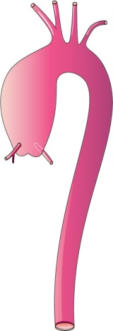
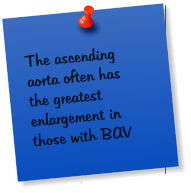
Awareness Alert for BAV Families - Look for the Bulge
When a bicuspid aortic valve is found in someone,
what does it mean to other blood relatives?
In checking other family members, the focus has been on the aortic valve. Generally, if the
aortic valve appeared to have a normal three leaflet structure, the person was considered
free from risk. But that is not the case. They may have, or over time develop, an
aneurysm.
The Bicuspid Aortic Foundation is aware of families with a variety of manifestations. For
example, in one family, two daughters had clearly identifiable bicuspid aortic valves and
ascending aortic aneurysms. When their mother was checked, she was told she had a
normal trileaflet aortic valve. However, the mother did have an ascending aortic aneurysm .
As more families with BAV are studied, it is clear that this condition can be complicated.
Some family members have a normal-appearing three leaflet aortic valve, but their aorta is
not normal, forming an aneurysm and sometimes dissecting (tearing).
The following paper describes 13 families with BAV that were studied:
Familial thoracic aortic dilation and bicommissural aortic valve: a prospective analysis of
natural history and inheritance. Loscalzo ML, Goh DLM, Loeys B, Kent KC, Spevak PJ, Dietz
HC. 2007. Am J Med Genet Part A 143A:1960-1967
It is important to note in this paper that in all 13 families, at least one person had an
ascending aortic aneurysm with a three-leaflet aortic valve (considered normal). Dissection
or rupture occurred in some of those tri-leaflet valve individuals. The authors wrote that a
single defective gene may cause these abnormalities of the valve and aorta independently of
each other. They recommend that "To avoid the risk of early death, it is essential that all first-
degree relatives receive echocardiographic follow-up at regular intervals regardless of the
presence or absence of a BAV. This assessment must include imaging of the aortic region
above the STJ." While these authors mention echocardiograms (sound waves), this test
may not adequately image the aorta, and another test such as an MRI or CT would be used
to screen the entire aorta.
In summary, when a BAV is found in someone, other family members are at risk of
aneurysms. When being screened, ask your physicians to "Look for the Bulge".
Finding aneurysms saves lives!












- Aorta
- BAV and Other Heart Valves
- Blood Pressure
- Exercise/Weight Lifting
- Featured Papers
- Guidelines
- Familial TAAD
- History
- Honoring Dr. M.E. Abbott
- Pictures (graphic content)
- Pictures Valvular Strand, Aneurysm (graphic)
- Prosthetic Heart Valves
- Scientific Awards
- Spotlight on Research - Coming Soon
- Video (graphic content)


